
How to Do RDLs: Essential Form & Muscles Worked
RDL means Romanian deadlift: a hip hinge that trains your hamstrings and glutes while your back supports the load. You begin standing, send your hips backward, then stand again without making floor contact the goal. The most useful form question is where the movement comes from. Your hips should do most of the bending. Reaching lower with the barbell means little if your torso position changes to gain extra depth. That distinction explains why two people can perform good RDLs at different depths. Body proportions and control affect the endpoint. One lifter stops near the knees; another reaches farther without losing the intended movement pattern.
This guide shows how to do RDLs, identify the muscles involved, and choose a manageable starting load. You will also learn how to check a repetition before increasing weight or adding more demanding exercise variations. Start by learning what a controlled repetition looks like. Then practice without equipment, add resistance, and record your sessions. The aim is repeatable technique that lets you challenge the intended muscles without guessing each workout.
What RDLs Work: Movers And Support Muscles
The hamstrings and gluteus maximus provide much of the hip extension that brings you upright. They belong to your posterior chain. The adductor magnus also assists, so the exercise involves more than two isolated muscles. Most hamstrings cross both the hip and knee. Keeping your knees softly bent while your hips fold loads these muscles as they lengthen. The biceps femoris short head differs: it does not cross the hip.
Your erector spinae and abdominal muscles help hold your torso steady. The lats keep the load near you, while your forearms maintain grip. These supporting jobs matter even when they produce less obvious muscular sensation.
Romanian deadlifts for hamstrings develop strength through hinging; they do not replace every knee bending exercise. Pairing an RDL with seated leg curls gives you practice loading the hamstrings through two different joint actions instead. A strong stretch is useful feedback, but neither burning nor soreness proves a productive set. Judge your training through controlled repetitions, appropriate effort, and progress over several sessions rather than how uncomfortable tomorrow morning feels.
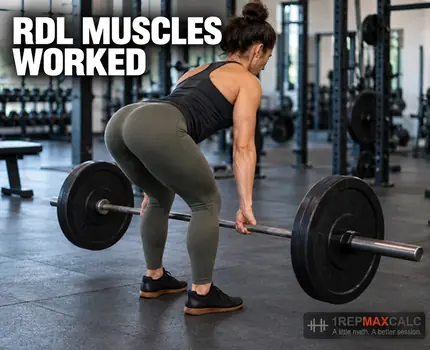
Learn The Movement With A Bodyweight RDL
For a bodyweight RDL, stand with your feet hip-width apart and soften your knees. Place your fingertips in the creases where your thighs meet your torso. Let that contact remind you where to initiate movement. Send your hips backward while allowing your chest to tip forward. Keep your feet planted and your shins nearly vertical. Stop when you feel manageable tension behind your thighs, then return smoothly to standing again.
Watch the difference between hinging and sitting down. If your knees keep moving forward as your hips drop, you are drifting toward squats. Try a shallower repetition, keeping the initial knee angle reasonably steady throughout. Film several repetitions from the side if you can. Check whether your hips travel backward and your torso moves as one controlled unit. Reviewing a recording is easier than twisting around during a loaded repetition. Move on when you can repeat that pattern comfortably without needing a new correction every time. Light dumbbells are an option before a barbell. An empty bar can still be too heavy for some beginners.

How To Do RDLs With A Barbell: Five Steps
First, secure the plates and take the barbell from a rack set slightly below standing hand height. Stand clear with hands outside your legs. Without a rack, use a controlled conventional deadlift to stand first.
Second, plant your feet at a comfortable width, with toes forward or slightly outward. Tighten your abdomen, keep your arms long, and soften your knees. Avoid exaggerating your chest lift or arching backward before starting.
Third, move your hips behind you and let the barbell descend close to your legs. Keep your knees softly bent rather than progressively sitting down. Your arms hold the weight; they do not reach downward.
Fourth, stop where you can still control the descent without changing your back position to gain depth. Mid-shin is not a compulsory destination. A shallower repetition is appropriate when it preserves your intended movement pattern.
Fifth, press through your feet and bring your hips forward to stand tall. Finish with your torso stacked over your pelvis, without leaning backward. Reset your breathing and abdominal tension before beginning the next repetition.

Fix The Rep Before Adding More Weight
If the barbell swings forward, slow down and keep it near your legs with your lats engaged. Let your elbows remain straight. The weight should follow your hip movement instead of pulling your arms forward. If your torso keeps dropping after your hips stop moving, end the repetition earlier. Practice with a dowel touching your head, upper back, and pelvis. Maintaining those contacts gives you feedback about unwanted spinal movement. If your toes lift, spread pressure across the heel and both sides of the forefoot. If your knees repeatedly travel forward, reduce the descent. Correct one visible problem at a time before adding more resistance.
Back muscles can work during RDLs without anything being wrong. However, stop for sharp pain, radiating symptoms, or worsening discomfort. Persistent symptoms deserve assessment by a qualified healthcare professional rather than repeated attempts with adjustments. If your hands fail first, wrist straps can help after you learn their use. Keep practicing your grip separately. Do not use equipment to push through painful wrists or to justify loads you cannot control.
Choose A Variation You Can Control
Dumbbells let each hand find a comfortable path around your legs. Use lighter weights while learning that path. They should remain close, without forcing you to reach forward or changing your posture to avoid contact. Kettlebells offer another option when that is the equipment available. Hold one with both hands, or one in each hand. The same movement applies: bend through your hips while controlling where the weight travels downward.
For training one side, start with both feet supported and place one behind the other. Keep most pressure through the front foot. The rear toes provide assistance while you learn to keep your pelvis level. Later, you can lift the trailing foot, allowing that leg to extend behind you as your torso inclines. A light hand support can prevent wobbling from ending the set before your working leg is challenged.
Choose the version that fits your equipment and current control. An RDL with barbell loading is convenient for gradual increases, but it is not automatically superior. Keep the exercise consistent enough to compare your performance.
Build An RDL Workout You Can Repeat
Here is a starting example, not a universal prescription: practice unloaded, then perform progressively heavier preparation sets. Begin with two working sets of eight repetitions, using a load that leaves about three good repetitions available. That remaining capacity is called reps in reserve. Stop before you need to change the movement to finish. Rest about two to three minutes between sets, taking longer when breathing or concentration has not recovered.
Start with one RDL session per week alongside your other training. If recovery and technique remain good, consider another session on a separate day. Count other demanding leg exercises when deciding whether more work helps. For a simple leg session, combine your RDL work with squats and a leg curl. Put your priority exercise first. If practicing the hinge is today’s main task, perform it before your legs become exhausted.
When both sets reach ten controlled repetitions with similar effort, add the smallest practical load and return to eight. This example gives you a clear progression target without requiring maximal attempts or continually changing exercises.
Track RDL Progress Without Chasing A Max
Record the load, repetitions, stopping depth, and how many good repetitions remained. Also note whether you used straps. These details make strength changes easier to interpret than recording the weight alone after every gym visit. For example, a 20 kg bar with 10 kg on each side weighs 40 kg overall. Eight repetitions becoming ten at comparable effort suggests improvement, provided your descent has not quietly become shorter over time.
Use our 1RM calculator to explore estimates from a recorded set and check practical loading options. Treat the output as a planning reference. It cannot assess your technique or confirm what you can lift safely. Do not borrow a percentage from your conventional deadlift record and assume it suits RDLs. The starting position, knee movement, and depth differ. Choose your RDL loads using repeatable sets of that same exercise instead. If a projected maximum rises after you shorten every repetition, the number may reflect a changed exercise rather than increased capacity. Keep your movement standard stable, and review your notes before celebrating a new record.
Frequently Asked Questions
RDLs primarily work your hamstrings and glutes. Your spinal extensors, abdominal muscles, and lats stabilize the movement, while your forearms maintain grip; the exercise emphasizes moving through your hips rather than bending your knees deeply.
Neither exercise is automatically harder. A conventional deadlift commonly allows more weight, while an RDL can feel demanding with less because you control the descent and hold the bar between repetitions without setting it down.
RDLs and hamstring curls train different actions, so neither replaces the other completely. RDLs emphasize hip extension, while curls emphasize knee flexion. Using both can make more sense than searching for a single universal winner.
An RDL is not better than squats for every purpose. RDLs emphasize loading the hamstrings through a hinge, whereas squats involve considerably more knee movement and challenge the quadriceps alongside the glutes during each repetition.
Use a load that lets you finish your intended repetitions while keeping the same controlled movement, with a few good repetitions still possible. There is no starting weight that suits everyone’s strength, coordination, and equipment.