
Dumbbell Row Alternatives: 7 Practical Options
No dumbbells, no bench, or a lower back that tires before your arms? Compare seven rowing exercises and choose the one that solves your equipment or setup problem.
If every dumbbell is in use, a seated cable row with a single handle lets you keep training one arm at a time. If you’re switching because your lower back tires before the muscles you’re trying to train, choose a machine with a chest pad instead. Both are good dumbbell row alternatives, but they solve different problems.
Use the one-arm dumbbell row form guide as your reference: your elbow bends, your upper arm travels back, and the weight comes toward the side of your ribs. Decide which part of that movement you want to keep before you choose what goes in its place.
Choose By The Equipment You Have
| If this is your constraint | Choose this row | What changes |
|---|---|---|
| Holding your torso up ends the set | Chest-supported machine row | The pad supports you; the handles follow the machine’s path. |
| You want one arm to work without bending over a bench | Seated cable row | A low pulley pulls forward instead of down. |
| You have a fixed bar or suspension straps but no weights | Inverted row | You pull your chest toward your hands; body angle sets the difficulty. |
| Your kit has to fit in a travel bag | Standing band row | A resistance band and a rated anchor are enough; tension rises as you pull. |
| You have a flat bench and a single bell | Bench-supported kettlebell row | You keep a one-sided load; the weight hangs below the handle. |
| Your gym has a landmine attachment | One-arm landmine row | The free end of the bar follows an arc. |
| You want to load both arms together | Bent-over barbell row | You can add weight plates, but you have to hold the forward lean yourself. |
All seven keep a horizontal pull relative to your torso. That’s why a reverse fly doesn’t make this list: it works parts of the upper back, but the elbow stays nearly straight. Renegade rows have a different limitation: the plank position may end the set before your back gets much work. Chin-ups train your lats too, but starting with your arms overhead makes that a vertical pull.
1. Chest-Supported Machine Row
Use this station when your back still has pulling strength but your torso starts rising on every rep. Sit facing the support and adjust the seat until you can reach forward without lifting your chest off it. Plant your feet, take a comfortable grip and draw your elbows back. Let your arms lengthen on the return while your chest stays in contact.
The advantage over free weights is easy to feel: you can concentrate on moving your arms without spending the set holding a hip hinge. The trade-off is fit. If the handholds force your shoulders up or you have to peel away from the support to finish, adjust the machine. If no setting works, a cable gives your hands more freedom. Leave a couple of reps in reserve while you find a comfortable setting. A first trial of 8–12 reps is enough to check whether that setting still suits you as the set gets harder.
2. Seated Cable Row
Use a D-handle for a single-sided pull or a wider attachment for two hands. Sit tall with a little bend in your knees. Reach far enough for your arm to straighten without letting the cable drag you off balance. Pull toward your lower ribs, then let the handle travel forward until you reach the same starting position. Keep your chest facing the pulley on a one-arm set.
Unlike a machine with a fixed path, the cable lets you choose where your elbow travels. Unlike a bench-supported dumbbell row, it pulls your hand forward while you sit upright. You still have to steady yourself: if you lean back farther with every rep, drop the pin one setting and see whether you can finish with the same torso angle you started with.
3. Inverted Row
Choose this bodyweight option when you have a securely racked bar that cannot roll or lift out, or a suspension trainer installed for the purpose. Begin with your body fairly upright. Hold yourself straight from shoulders to heels, draw your chest toward your hands, then lower until your elbows straighten. Your hips and chest should move together. If your hips arrive first, make the angle easier.
For a simple progression, bring your torso closer to horizontal; to ease the pull, raise the bar or stand more upright on the straps. Mark where your heels start so you can repeat the setup. In a study comparing three rowing exercises, the inverted version produced the lowest measured lumbar load of the three. That helps explain this choice when holding a forward lean is the limiting task; it doesn’t make an improvised table a suitable anchor.
4. Standing Resistance Band Row
For home workouts or travel, a band is portable enough to take along, but you still need a secure attachment at about lower-chest height. Inspect the elastic and anchor, then step back until there’s a light pull with your arms extended. Stagger your feet, draw your elbows toward your sides and return smoothly. Keep your feet planted rather than taking a step back to finish each rep.
The last few inches are usually the hardest because the elastic stretches farther. If you can start a rep easily but can’t finish without leaning away, step closer or use a lighter band. A printed resistance range won’t tell you what you pulled on each rep. Use the same band, anchor height and foot position to compare sessions.
5. Bench-Supported Kettlebell Row
If the only thing missing is the dumbbell, this is the closest swap. Brace your free hand on a solid bench, keep both feet planted and let the bell hang under the working shoulder. Guide your elbow back beside your ribs. Give the round body of the bell room to clear your thigh, then lower it without letting it swing forward into the next rep.
You keep the same elbow action and the same downward pull from gravity. What changes is where the mass sits relative to your hand. Test a few light reps to find a path that clears both leg and bench. If the available bells jump from manageable to too heavy, add clean repetitions first instead of twisting for a weight you can’t yet control.
6. One-Arm Landmine Row
Choose this when you like a single-sided row but have a bar and pivot station instead of a dumbbell rack. Secure one end in the pivot, load the other according to the equipment instructions and stand beside the loaded end, facing along the bar toward the pivot. Hinge, steady your free hand on a firm support if needed, then row the loaded end past the outside of your leg.
The pivot determines where the bar can go. Start with a light plate and try the movement before adding more: if the disc meets your torso before your elbow comes alongside you, smaller-diameter plates may give you more room. The thick end can also tire your hand early. Use a compatible rowing handle if available. A number stamped on the plate isn’t the equivalent dumbbell weight; the pivot supports part of the load. Before your working sets, find a starting spot that lets the loaded end clear your knee going both up and down.
7. Bent-Over Barbell Row
This is the option for lifting with both arms when you’re comfortable holding an unsupported stance. Start standing with the bar, soften your knees and send your hips back. Let the bar hang beneath your shoulders, then bring it toward your abdomen without standing taller. Lower it until your arms straighten. Choose a torso angle you can keep through the last rep.
In the study mentioned above, seven healthy men performed all three lifts. The standing bent-over version placed the highest load on the lumbar spine under those test conditions. The practical test is simpler: if your trunk gives out with several pulls left in your arms and back, choose a supported station next time. A heavier bar offers little advantage if each repetition turns into a different lift.
Put The Swap Into Your Workout
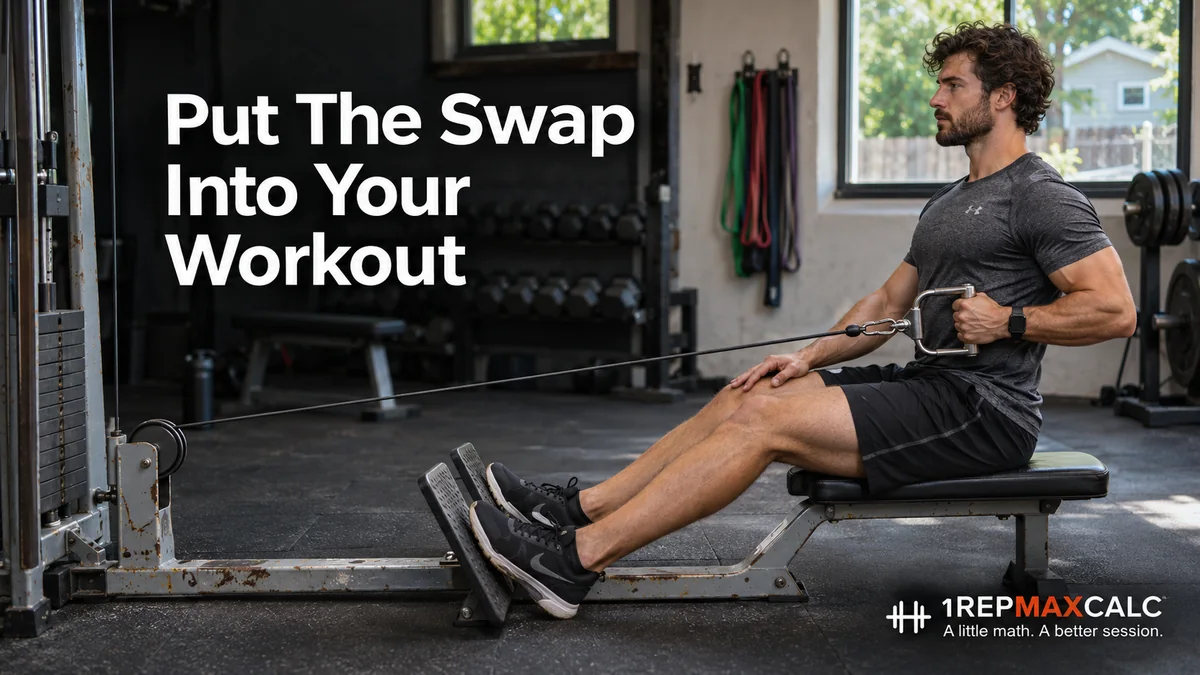
Replace the row already in your plan; you don’t need to add all seven. Suppose your session calls for two sets of eight to twelve repetitions per side. On the cable, start with a light practice set: plant both feet on the footplates, pick a pin on the weight stack and see whether you can pause at the finish. If you switch to a two-arm version, do two sets with both arms together. Don’t double the number of sets to account for the second arm.
For the first session, stop each set while you could still do about two more clean repetitions. If you get ten smooth pulls today and twelve next time with similar effort, the extra repetitions are a sign of progress. Change one thing after that: move the machine pin, increase band tension slightly, or make the inverted row a little flatter. Note seat height on a machine, starting distance for a band, and the handle or sleeve you used for a landmine. Those details make the next comparison meaningful.
For a free-weight lift you already track, the one-rep max calculator can estimate performance from a completed set. Keep estimates specific to the lift. A 20 kg dumbbell, 20 kg on a cable stack and 20 kg on the end of a pivoting bar do not put the same resistance in your hand.
Frequently Asked Questions
What Can I Do Instead Of A Chest-Supported Dumbbell Row?
Use a machine row with chest support if you want to keep your torso still. If the bench is taken but a pulley is free, a one-arm cable row is another choice, though your trunk does more of the steadying.
What Can I Use In Place Of A Dumbbell?
For rows, a kettlebell is the closest handheld substitute. If you have no loose weights, use a band on a secure anchor or pull your body toward a properly installed bar.
What Is The Dumbbell Equivalent Of Cable Rows?
A dumbbell row with one hand braced on a bench is the closest one-sided match. For both arms together, lie chest-down on an angled bench. Your elbows still travel back, but the weights pull downward. Without an incline bench, use the one-arm version.
What Is A Good Substitute For A Barbell Row?
Use a seated cable row for a two-arm pull or a machine row for more torso support. If you want to keep the forward lean, a landmine row with a slight knee bend is a better match.
Can A Pull-Up Replace A Dumbbell Row?
Only partly. Pull-ups and chin-ups train the lats and elbow flexors, but your elbows come down from above your head. Keep a row when your plan calls for pulling toward your ribs.